Drip irrigation delivers water and fertiliser straight to the roots — the leaves stay dry, fungal diseases cannot spread, and every litre of water is used where it counts. The system takes only a few components to build: a water source, a main valve, a pressure regulator, a disc filter, a fertiliser injector, a Ø40 mm main pipe and drip tapes. A complete kit for a 400 m² greenhouse costs ≈850 GEL, and under the "Plant the Future" programme the state covers 50% of the cost of installing drip irrigation. In this article we walk through the bill of materials, the installation sequence and soil care — from mulching to solarization.
How drip irrigation works in a greenhouse
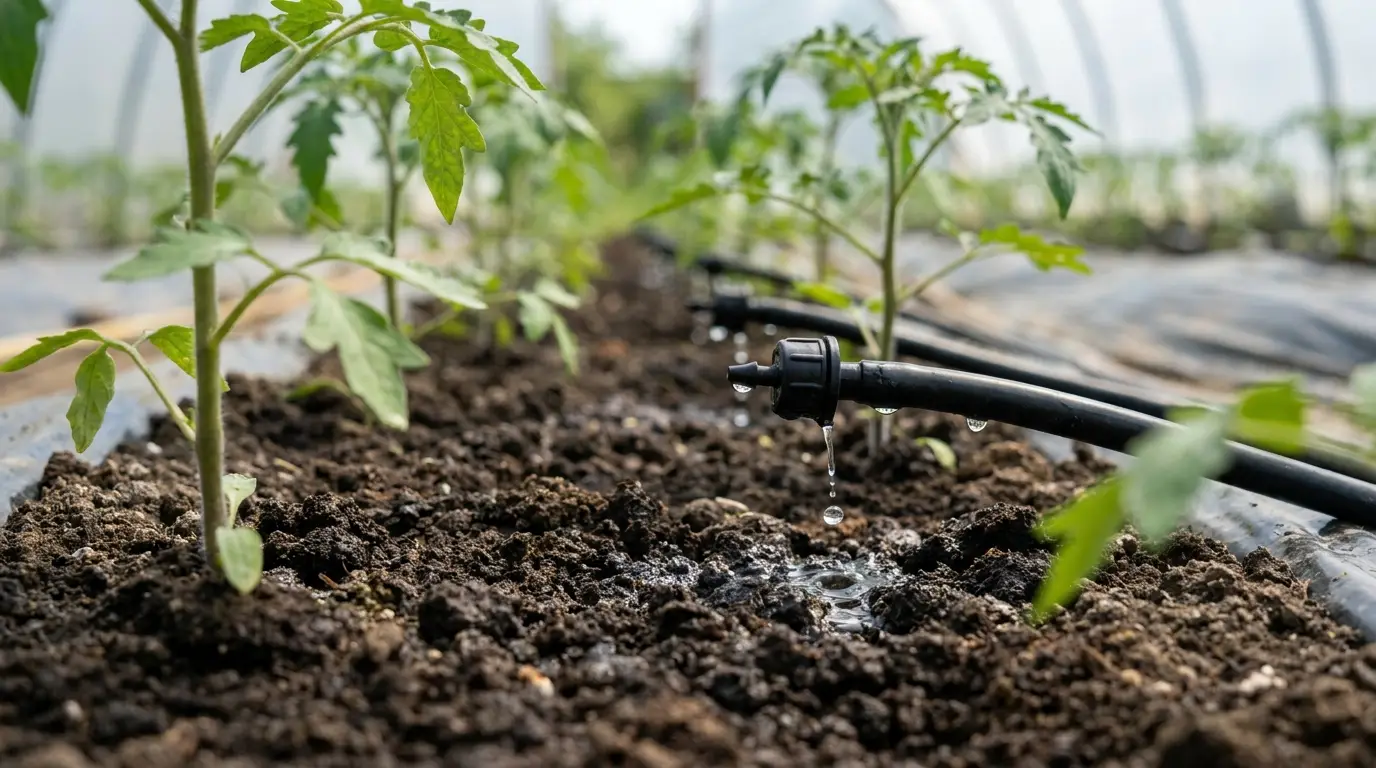
Drip irrigation feeds water drop by drop, slowly and evenly, to every plant. A thin-walled tape has an emitter built in every 20 cm, each releasing 2 litres per hour. The system runs on low pressure (1.0–1.2 bar), so a pressure regulator and a filter between the water source and the tapes are essential. Dry foliage sharply cuts the risk of fungal disease — and proper ventilation helps keep humidity in check too.
Drip irrigation bill of materials (BOM) — for a 400 m² greenhouse
Take a project calculated with FAO/UGA methodology: a 10×40 m greenhouse with 4 beds — 2 side beds (1.3 m wide, 2 tapes each) and 2 central beds (2.5 m wide, 4 tapes each), 12 irrigation lines in total. The complete kit costs ≈850 GEL — roughly a tenth of the whole build's materials budget. The full cost breakdown is in a separate article: how much a greenhouse costs.
| Component | Specification | Quantity |
|---|---|---|
| Main pipe | Polyethylene, Ø 40 mm | 12 m |
| Drip tape | Emitters every 20 cm, flow 2.0 L/h | 480 m (12 lines × 40 m; buy a 500 m roll) |
| Disc filter | 1.5-inch, 120 Mesh (130 micron), capacity 10–12 m³/h | 1 pc |
| Pressure regulator | 1.5-inch, outlet pressure 1.0–1.2 bar | 1 pc |
| Venturi injector | 1-inch, with a bypass assembly — for fertigation | 1 pc |
| Fittings and valves | 12 start connectors with taps, 12 tape end closures, Ø 40 mm elbow and end cap, 1.5-inch ball valve | 1 set |
A simple filter selection rule: emitters with 2 and 4 L/h flow need a 120 Mesh disc filter; 8 L/h emitters need 100 Mesh. The filter's capacity must cover all lines running at once — at least 10–12 m³/h in our example.
Drip system installation step by step
Include drip irrigation in the greenhouse design from day one — retrofitting costs more. Request a free consultation and get a layout tailored to your beds plus a cost estimate.
Maintaining a drip system — clog prevention
The emitters' main enemy is clogging: sand, bacterial slime and limescale. The filter is the first line of defence; periodic flushing handles the rest:
Continuous chlorination — at 1–2 mg/L, to prevent biological film and bacterial slime from developing.
Periodic chlorination — 10–20 mg/L for 1 hour, to remove heavy biological deposits.
Shock chlorination — up to 500 mg/L, to clear clogged pipes — only in an empty greenhouse!
Acid treatment — lowering the water pH to 5.5 with nitric or orthophosphoric acid dissolves carbonate and iron deposits in the pipes.
Healthy greenhouse soil: the mix, organic feeding and mulch
The harvest depends on soil quality. Use a light, loose and fertile mix in the greenhouse, with pH between 6.0 and 6.8:
- Soil mix — 40% peat or compost (for moisture and humus) + 20% river sand or perlite (for drainage) + 40% black soil (the base structure)
- Organic feeding — every season add 5–8 kg of well-rotted manure or compost per 1 m²
- Mulching — a 5–7 cm layer of straw or black film cuts water evaporation by 40% and blocks weeds — a perfect match for drip irrigation
Solarization — natural soil disinfection
Solarization heals the soil without chemicals: in summer, thanks to the greenhouse effect and a clear film cover, the top soil layer (0–10 cm) heats up to 50–60°C. This heat destroys Fusarium, Verticillium, Rhizoctonia and Colletotrichum, noticeably reduces nematodes, and after solarization beneficial heat-tolerant microorganisms activate in the soil and yields rise. The best time is July–August; the process takes about 5 weeks, with a weekly field-log entry recording temperature and checking the seal.
Solarization field checklist (400 m²)
0/6FAQ: drip irrigation and greenhouse soil
How much does a drip system for a greenhouse cost?
A complete kit for a 400 m² greenhouse (500 m of tape, a 1.5-inch disc filter, a pressure regulator, a Venturi injector, fittings) costs ≈850 GEL; a kit for a small family greenhouse — ≈120 GEL. Our turnkey construction (film 75–85 GEL/m², polycarbonate 200–250 GEL/m²) includes drip irrigation as standard — see greenhouse construction.
Does the state finance drip irrigation?
Yes — the "Plant the Future" programme covers 50% of the cost of installing a drip system (up to 5,000 GEL per hectare). Greenhouse construction itself falls under the agro co-financing programme — details on the programme page.
Why do emitters clog and how do I prevent it?
For three reasons: sand and debris, bacterial slime, and limescale or iron deposits. Prevention takes a 120 Mesh disc filter at the inlet, preventive chlorination at 1–2 mg/L, and an acid flush (pH 5.5) when needed.
When should I run solarization?
In July–August, during peak sunshine — the process takes about 5 weeks and is done in an empty greenhouse. Clean, till and generously irrigate the soil beforehand, and lay the film airtight.
Need an irrigation system in your greenhouse?
We design and install drip systems in both new and existing greenhouses. Send us the dimensions and your crop — you'll get an exact estimate within 24 hours. The consultation is free.