Greenhouse farming is a profitable business in Georgia if you get three things right: what to grow, when to reach the market, and how much you spend on heating. A greenhouse's core economic advantage is season management — you sell produce when open-field harvests are absent from the market and prices are at their peak. You don't need large capital to start: materials for a small DIY greenhouse cost ≈2,711 GEL, materials for a 400 m² film greenhouse ≈8,500 GEL, and turnkey construction with film costs 75–85 GEL/m². On top of that, state co-financing covers 50% of the cost. Below we go step by step: what to grow, where to sell, and how to start.
What to grow in a greenhouse for the Georgian market
As FAO observes, in Mediterranean countries — with a climate similar to Georgia's — it was greenhouses that made year-round market supply possible. The University of Georgia (UGA) manual adds: a greenhouse is a season-management tool — you start work in early spring, keep warmth through winter, and comfortably grow warm-climate plants. For a Georgian farmer this translates into three main directions — plus a fourth one that is often forgotten:
- Heat-loving vegetables (tomatoes, cucumbers and similar crops) — reaching the market before the open-field season starts and after it ends, when prices are high
- Frost-hardy crops (herbs, leafy greens) — for the winter months the manual recommends exactly this: frost-hardy production tolerates a much lower temperature regime and keeps heating costs to a minimum
- Seedling production — seedlings raised in early spring in a hotbed or cold frame sell to neighbouring farmers and supply your own greenhouse
- Diversification — the manual's introduction itself teaches production diversity: combining several crops and seasons reduces the risk of depending on a single market
| Direction | Price window | What it takes |
|---|---|---|
| Early seedlings | Early spring — before planting season | Hotbed or cold frame, minimal heating |
| Heat-loving vegetables | Early spring and late autumn | Unheated high tunnel or film greenhouse |
| Frost-hardy crops | Winter — the highest prices | Low temperature regime, minimal heating |
| Year-round intensive production | 12 months — steady supply | Heating + energy-saving technologies |
Where to sell the harvest
Plan your sales channel before the harvest comes in — that is one of the core rules of greenhouse business. For a small or mid-sized farmer the realistic channels are:
- The local farmers' market — the simplest starting channel: minimal barriers, you control the price yourself, but it takes your time
- Wholesale / resellers — saves time on large volumes, in exchange for a lower price
- Direct orders — neighbours, social media, pre-agreed deals: this is where the best price is made
- Shops, restaurants, hotels — steady volumes, but with quality and regular-delivery requirements
- Cooperation — joining forces strengthens farmers' bargaining position and lets them share costs; on top of that, the state supports cooperatives and women farmers with a separate grant programme — up to 90% co-financing of a small family greenhouse in specific municipalities
Seasonality and price windows
The whole logic of greenhouse business rests on price windows: income peaks when little local produce is on the market — late autumn, winter and early spring. But that is exactly when costs rise too: according to the manual, energy is the greenhouse owner's third-largest expense after labour and seeds/seedlings, often exceeding 10% of sales revenue, and 70–80% of energy costs go to heating. So before entering the winter window, make sure the high price outweighs the heating bill — or choose an energy-saving route:
- An unheated high tunnel — for the spring and autumn windows, daily solar energy alone is enough
- Double inflated film — cuts heat loss by 30–40%
- Root-zone heating — you heat the roots directly instead of the air and save 20–30% of fuel
- Thermal screens — cut heating energy by 30–50%; details in the heating and energy efficiency article
- East–west orientation for winter production — the low winter sun warms the long south wall all day; we cover site selection in a separate article
For a beginner the safest strategy is the 'shoulder' price windows — early spring and late autumn with an unheated greenhouse. Move to full winter production once your sales channel is already up and running.
Starting investment: two real budgets
The manual contains two real DIY bills of materials at 2026 market prices — they illustrate the starting scales of the business well:
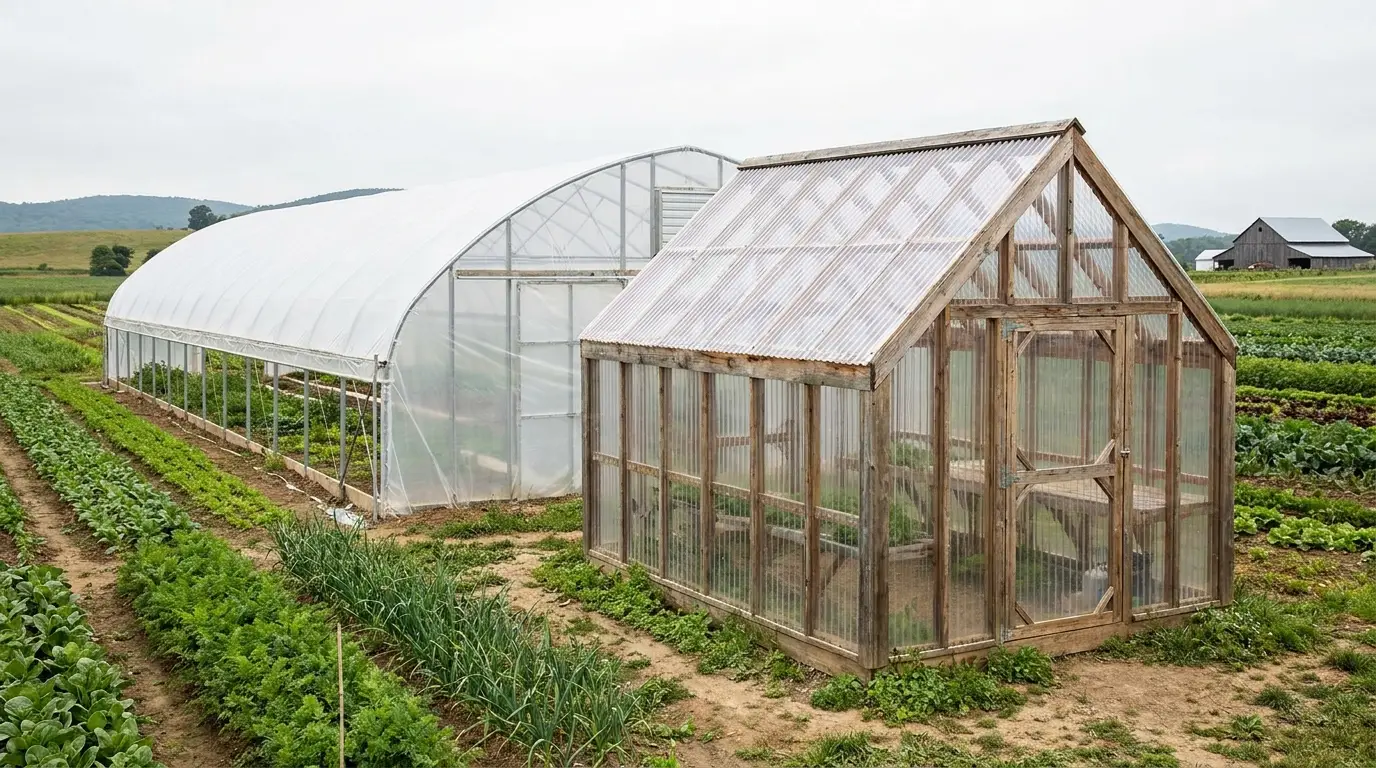
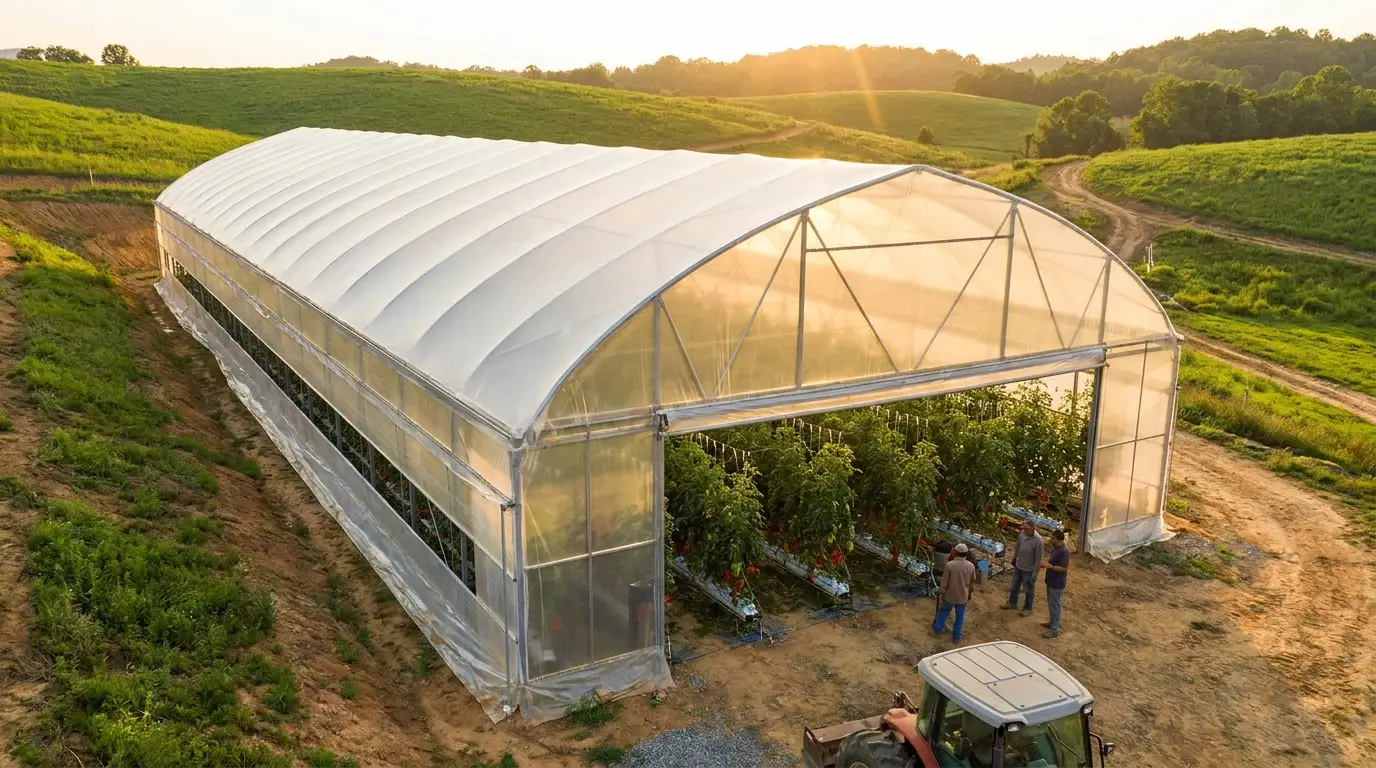
- Project A — a 400 m² (10×40 m) steel arch film greenhouse: materials ≈8,500 GEL (≈21–25 GEL/m²), including drip irrigation and side ventilation — a starting size for commercial production
- Project B — a 17.3 m² wooden gable polycarbonate greenhouse: materials ≈2,711 GEL (≈150–160 GEL/m²) — a format for family production and trying out the seedling business
- Turnkey construction: 75–85 GEL/m² with film, 200–250 GEL/m² with polycarbonate — with design, installation and handover; details on the greenhouse construction page
Always add 15% for unforeseen expenses to the budget — the manual's own readiness checklist requires it. A full price breakdown — from structure to film — is in a separate article: how much a greenhouse costs.
Co-financing: the state covers half the cost
State co-financing covers 50% of greenhouse construction costs — the conditions and application process are described in detail on the agro co-financing page. The manual points to further programmes as well: under the new agro co-financing programme, the application and business plan first go to the Rural Development Agency (RDA), and only after approval do you go to the bank — the loan interest is subsidised. The 'Plant the Future' programme finances 50% of a drip irrigation system (up to 5,000 GEL per hectare) — we have a separate article on irrigation: irrigation systems and soil. Registration in the farmers' registry is mandatory for participation.
How to start: the business checklist
Greenhouse business launch checklist
0/8Frequently asked questions
Is greenhouse business profitable in Georgia?
Yes — if you aim production at the price windows: early spring, late autumn and winter, when open-field produce is absent from the market. The key conditions are controlling heating costs (70–80% of energy spending is heating) and a sales channel planned in advance. Co-financing then halves the starting investment.
How much money do I need to start?
Materials for a small family DIY greenhouse start at ≈2,711 GEL; materials for a 400 m² commercial film greenhouse are ≈8,500 GEL. Turnkey construction costs 75–85 GEL/m² with film and 200–250 GEL/m² with polycarbonate — co-financing halves the sum. Details: how much a greenhouse costs.
Which crop should I start with?
For a beginner the easiest path is heat-loving vegetables in the early-spring and late-autumn windows with an unheated greenhouse. For winter the manual recommends frost-hardy crops (herbs, leafy greens), while seedling production in early spring is an extra income stream.
Is winter production possible in Georgia?
It is, but heating is the biggest operating expense. To cut it, use double inflated film (−30–40% heat loss), root-zone heating (−20–30% fuel) and thermal screens (−30–50% energy) — covered in detail in the heating article.
Start your greenhouse business with the right numbers
Tell us what you plan to grow and on what area — we will prepare a design and cost estimate and help with the co-financing application. [The consultation is free](/servisebi).