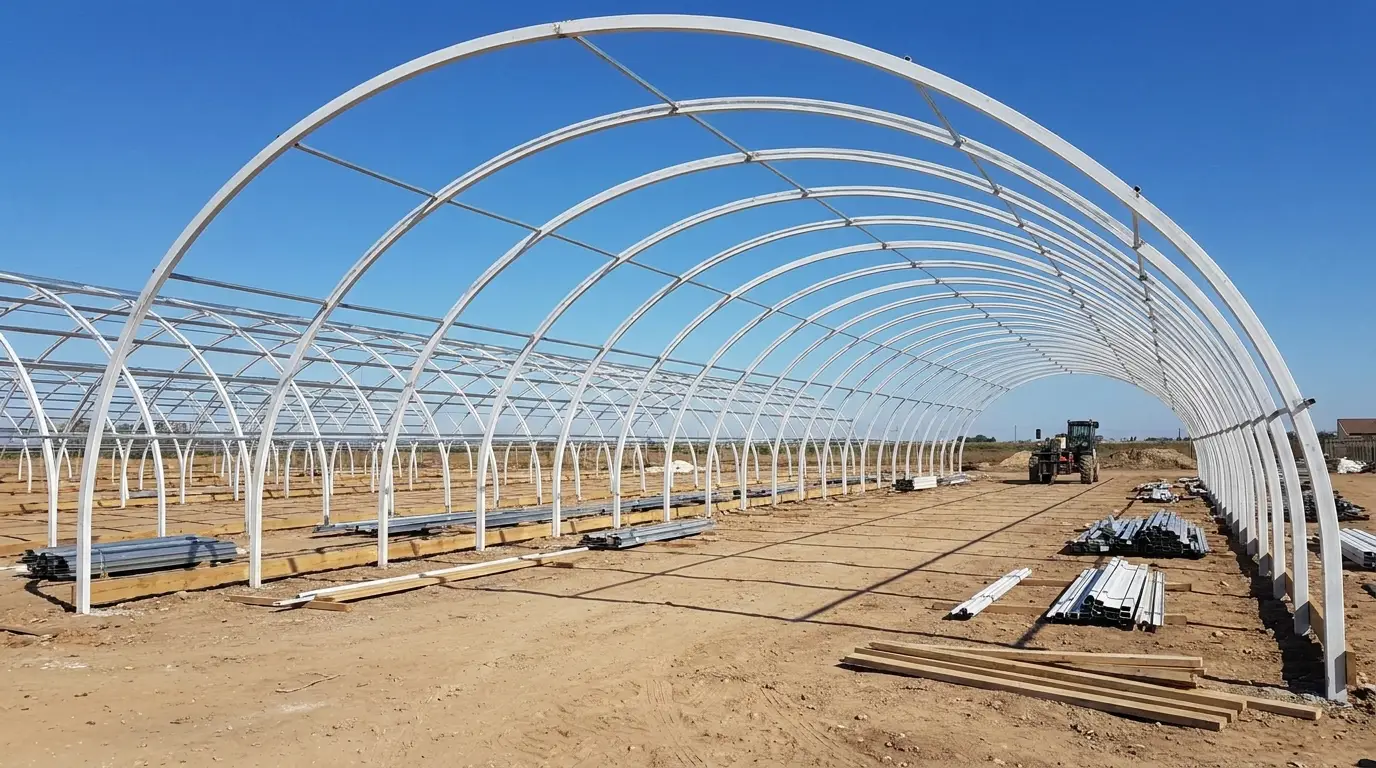
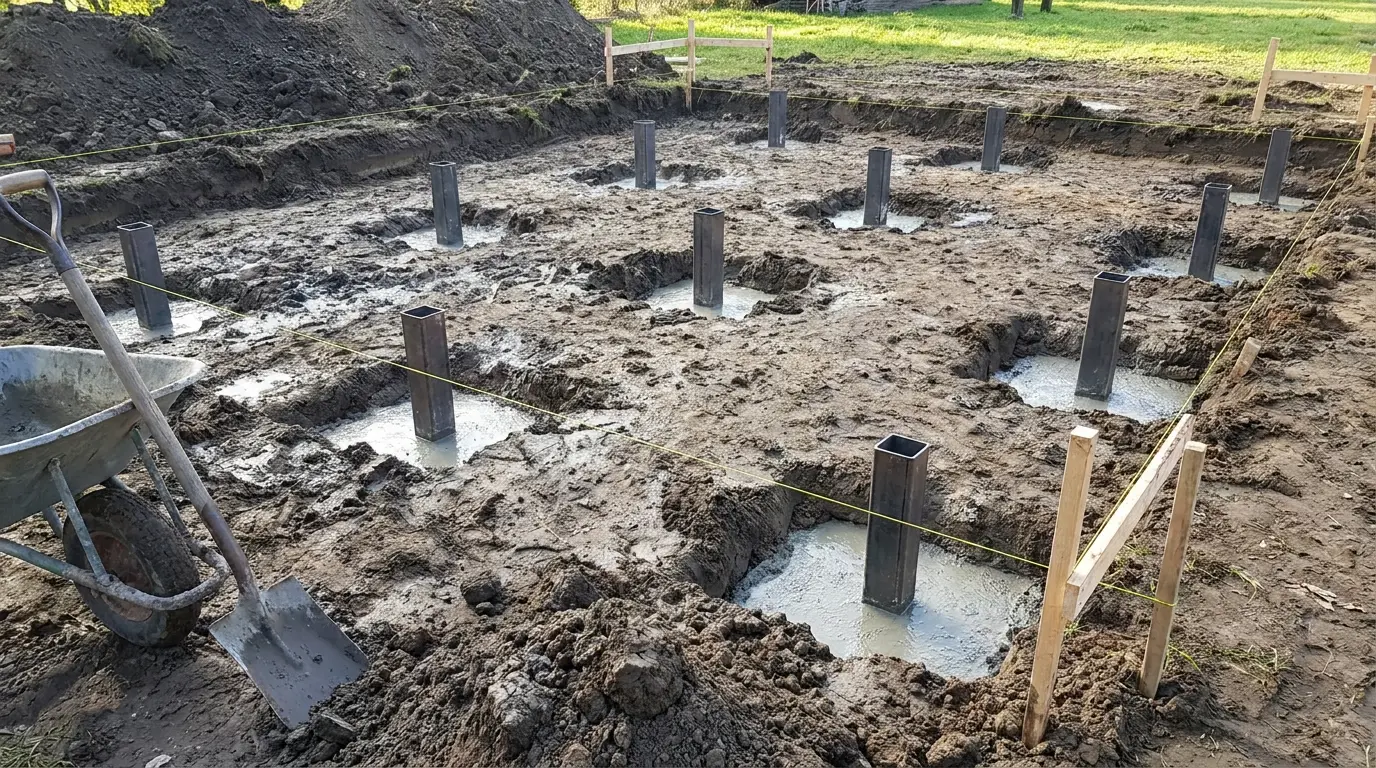
The mistakes that cost farmers the most when building a greenhouse are three: a structure not engineered for snow load, which buckles under the first wet snowfall, a shallow foundation, which a strong wind rips out of the ground entirely, and insufficient ventilation, which cooks the crop in summer. Avoiding these mistakes at the design stage costs almost nothing; fixing them often costs the entire investment. In this article we break down the 10 most common mistakes from a handbook based on FAO/UGA methodology — for each one you will see what goes wrong, what it costs and how to do it right.
Why one mistake can cost the whole investment
A greenhouse is a lightweight structure, and nature presses on it from two sides: snow from above in winter, wind from the side all year. In Georgia both factors change sharply by region: the west gets little but wet, heavy snow; in the mountains a thick cover sits for months; on the plains the main threat is wind. Building 'from the neighbour's drawing' does not work — what survives in Imereti may not last one winter in Javakheti.
The single most expensive mistake is a structure built without calculating the weight of snow. Do not look at snow depth alone: because of the 'Batumi phenomenon', 15 cm of wet snow loads 60–75 kg onto every square metre, while 40 cm of dry snow in Akhaltsikhe adds only ≈32 kg. 20 cm of wet snow on a low-pitched roof is ≈90 kg/m² — 9 tonnes on a 100 m² greenhouse. Randomly chosen tubing bends under that weight within hours.
The 10 mistakes and how to fix them
Tube sizes by region — a cheat sheet
The handbook's engineering table for round black-steel tubes with a 1.0 m arch spacing and no internal supports:
| Tube diameter | Max greenhouse width | Max snow load | Recommended regions |
|---|---|---|---|
| DN 20 (26.8 mm) | 3.0–4.0 m | 30 kg/m² | Tbilisi, Kvemo Kartli |
| DN 25 (33.7 mm) | 4.0–6.0 m | 50 kg/m² | Shida Kartli, Kakheti, Kutaisi |
| DN 32 (42.4 mm) | 6.0–8.0 m | 80 kg/m² | Adjara, Samegrelo, Guria, Samtskhe-Javakheti |
| DN 40 (48.3 mm) | 8.0–10.0 m | 100+ kg/m² | Mountain regions, commercial greenhouses |
How to avoid all ten mistakes at once
Everything on this list shares one trait: the mistakes are born at the design stage and get locked in during installation — after which fixing them costs more than the build itself. Building yourself? Use the handbook's calculations and this list as a checklist. If you would rather not take the risk, turnkey construction costs 75–85 GEL/m² for a film greenhouse and 200–250 GEL/m² for polycarbonate, with a design engineered for your region's wind and snow included. State co-financing covers half the cost — request a free consultation for an exact estimate.
Frequently asked questions
How do I calculate the snow load on my roof?
Multiply snow depth (in metres) by its density and the roof-slope coefficient. Wet snow is ≈450 kg/m³; for roofs pitched under 30° the coefficient is 1.0: 0.2 m × 450 × 1.0 = 90 kg/m². Before heavy snowfall, place temporary prop posts under the ridge at every second or third arch — they transfer the pressure straight to the ground.
Which shape is best in a snowy region?
The gothic arch: snow slides off its pointed ridge and steep sides under its own weight. The top of an ordinary semicircular arch is almost flat — snow piles up exactly there. In an emergency, run the heating at maximum (indoor temperature 15–18°C) — the bottom layer of snow melts and the whole mass slides off by itself.
Can galvanized tubes be welded?
No — welding burns off the protective zinc layer, the seam starts rusting immediately, and zinc fumes are poisonous ('metal fume fever'). Galvanized structures are assembled factory-style with bolts. If a weld has been made anyway, treat it immediately with cold-galvanizing spray.
What does preventing these mistakes cost with a professional design?
A turnkey film greenhouse costs 75–85 GEL/m², a polycarbonate one — 200–250 GEL/m², and the price includes an engineering design tailored to your region. Under the co-financing programme the state covers 50% of the cost. Detailed breakdown: how much a greenhouse costs.
Want a greenhouse that survives its first winter?
Send us the dimensions and your region — we will engineer the design for your zone's wind and snow loads, and you will receive an estimate within 24 hours. The consultation is free.