Choosing a greenhouse type follows simple logic: for commercial seasonal production the best option is a tunnel (arch) film greenhouse — the cheapest and most wind-resistant choice (turnkey at 75–85 GEL/m²); for family year-round use — a gable polycarbonate greenhouse (200–250 GEL/m²); and in snowy regions — a gothic arch, which sheds snow by itself. The right combination of shape, structure and covering determines whether the greenhouse survives snow and wind and how much keeping it warm will cost — this article compares all the options.
Greenhouse types by shape
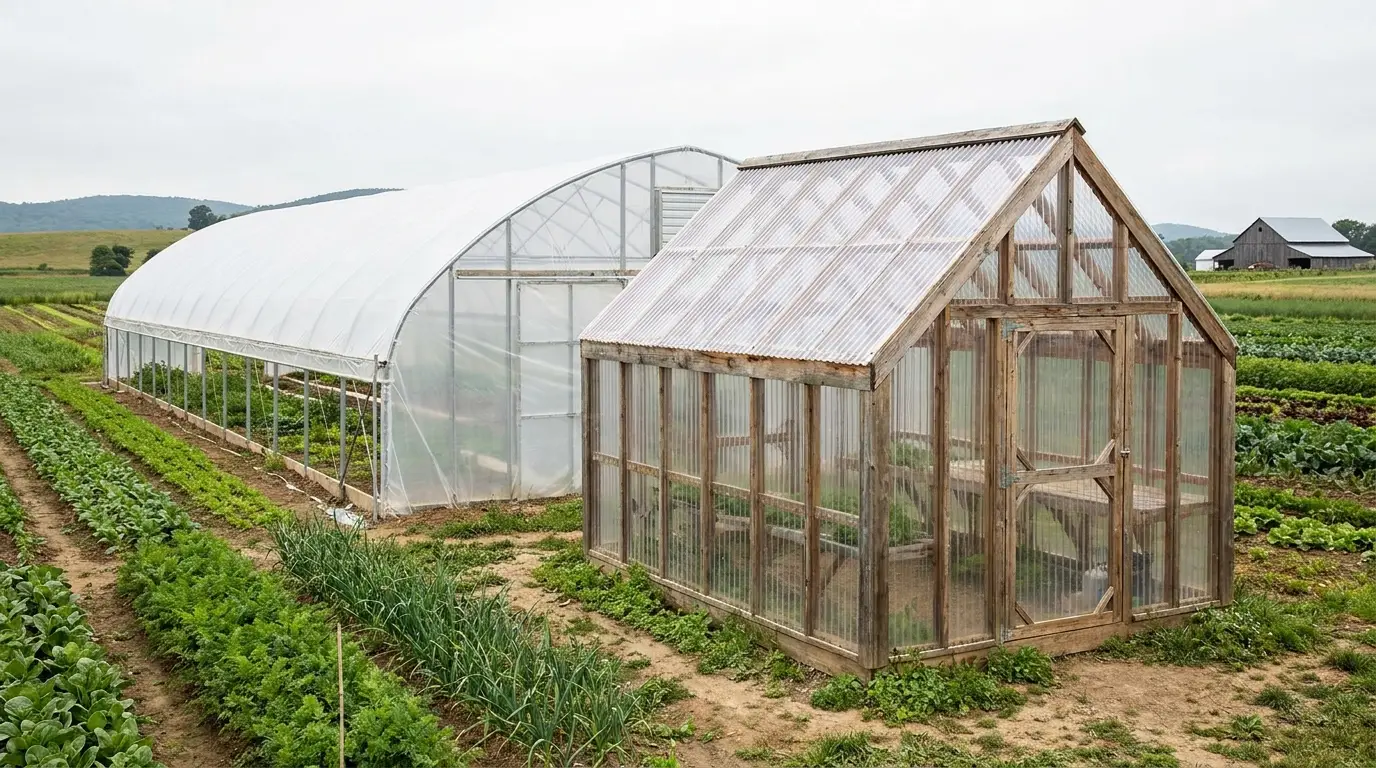
When choosing the shape, weigh three things: plot size, budget and local climate. In practice you will meet four main types:
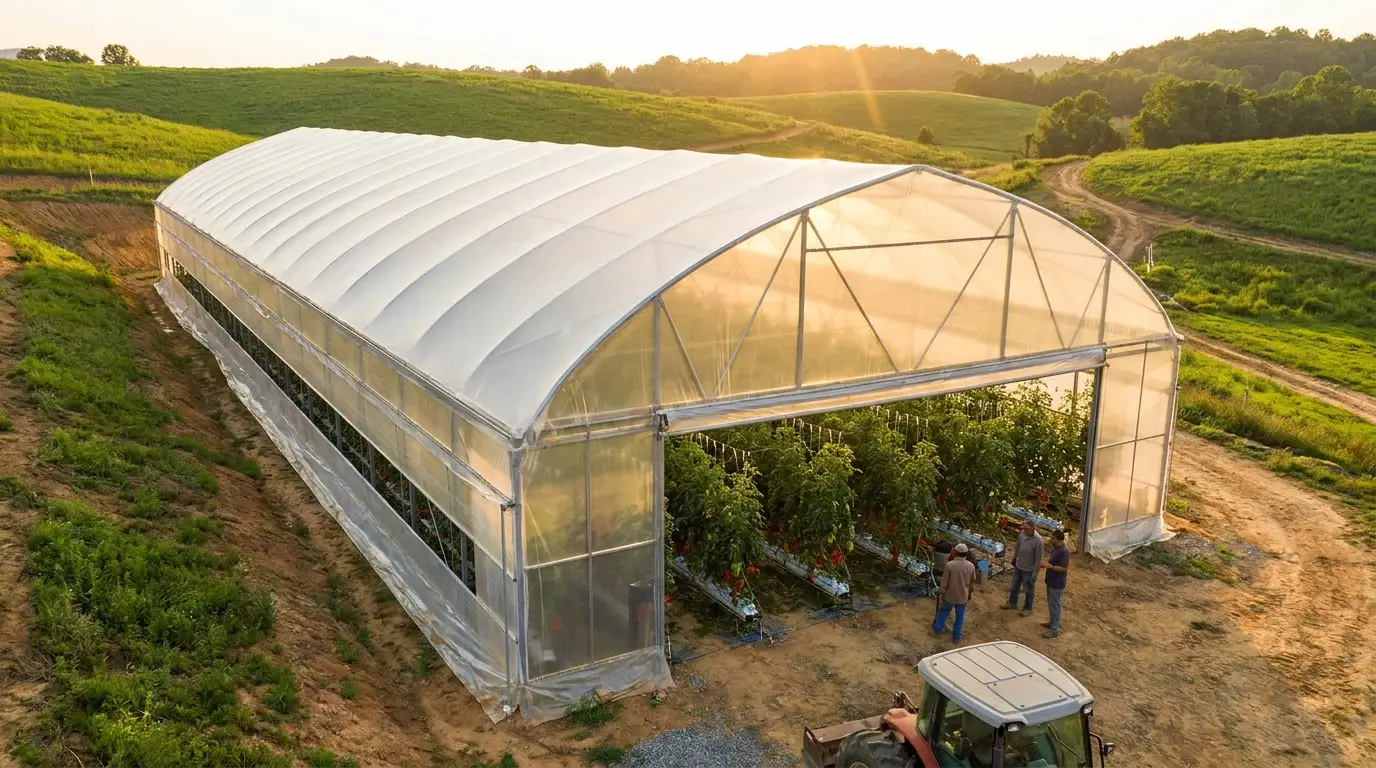
- Tunnel (Quonset) — the most common and cheapest: film stretched over semicircular steel arches. Simple assembly, good aerodynamics, minimal shading; but it struggles under snow unless reinforced
- Gable (even-span) — a classic symmetrical roof with an optimal pitch of 6:12 (≈27°). Large interior and good light all day long; the large surface loses heat quickly on winter nights
- Gothic arch — a blend of tunnel and gable with a pointed ridge: snow slides off the roof by itself, and the high ceiling improves air circulation. The best choice for snowy regions
- Lean-to — attached to the south wall of a house: the wall shields it from cold northern wind and holds heat at night, but light enters from only three sides. A low-budget family option
Tunnel or gable greenhouse — which should you pick?
Tunnel film greenhouse
- Lowest price (turnkey at 75–85 GEL/m²)
- Simple, fast assembly
- Good aerodynamics — stands up to wind well
- Minimal shading from the structure
- Snow accumulates on the rounded ridge — needs reinforcement or clearing
- Curved sides make vertical space awkward at the edges
- Film is replaced every 3–4 years
Gable polycarbonate greenhouse
- Snow slides easily off the 27° pitch
- Large interior — fits 2–3 benches and full-height crops
- Good light from all sides throughout the day
- Polycarbonate lasts 7–10 years
- More expensive (turnkey at 200–250 GEL/m²)
- The large surface means high heat loss on winter nights
Greenhouse structure material: steel, timber or PVC
The structure carries the greenhouse's entire weight, so material choice is critical. In Georgia the main DIY material is black steel tubing: it is cheap, bends easily and can be welded with an ordinary welder right on site. After welding, the structure must be treated with two coats of anti-rust primer and white paint — the white colour protects the tubes from overheating (in summer a tube heats up to 70°C, and hot metal burns through the film) and improves light reflection. We cover this in detail in a separate article: structure assembly and tube sizes.
| Frame material | Lifespan | Shading | Cost |
|---|---|---|---|
| Black steel tubing (painted) | 15–20 years | Minimal (5–8%) | Low / affordable |
| Factory galvanized | 25+ years | Minimal (5–8%) | High |
| Timber (antiseptic-treated) | 5–10 years | High (20–25%) | Medium |
| Plastic (PVC) | 1–2 years | Low (8–10%) | Very low |
Always treat a timber structure with a water-based antiseptic before use. Never use creosote or used engine oil — their toxic fumes damage plants inside the greenhouse. Welding galvanized tubes is also dangerous: burning zinc gives off poisonous fumes, and the protective layer burns away at the welds.
Two reference projects: a large tunnel and a small gable greenhouse
For comparison, here are two reference DIY projects calculated with FAO/UGA methodology at 2026 market prices — a commercial steel tunnel and a family timber gable (based on the UGA CT 238 plan):
| Parameter | Project A — steel tunnel |
|---|---|
| Size and area | 10×40 m = 400 m² |
| Purpose | Commercial production |
| Frame | Black steel tubes, 21 arches every 2 m |
| Covering | Agro Ornament standard 180-micron, five-component film (UV/IR) |
| Foundation | Concrete piers (50 supports) |
| Materials budget (DIY) | ≈8,500 GEL (≈21–25 GEL/m²) |
| Usable floor area | 76% |
| Parameter | Project B — timber gable (UGA CT 238) |
|---|---|
| Size and area | 3.6×4.8 m ≈ 17.3 m² |
| Purpose | Family plot, seedlings |
| Frame | Antiseptic-treated pine lumber |
| Covering | 6 mm twin-wall polycarbonate |
| Foundation | Timber structure on a gravel bed |
| Materials budget (DIY) | ≈2,700 GEL (≈150–160 GEL/m²) |
| Usable floor area | 83% |
A square metre of a small greenhouse costs more — fixed costs are spread over a small area. So for commercial purposes one large greenhouse beats several small ones. We break down the full budget in a separate article: how much a greenhouse costs, and you can see examples of both types on our projects page.
How to choose your greenhouse type — 5 steps
Frequently asked questions about greenhouse types
Which greenhouse is best for a beginner farmer?
A tunnel film greenhouse — the cheapest (turnkey at 75–85 GEL/m²), easy to assemble and wind-resistant. The structure lasts for years, and replacing the film is inexpensive. Later you can switch the same steel structure to polycarbonate.
Which structure handles snow best?
The gothic arch — snow slides off the pointed ridge and steep sides under its own weight. A gable roof with a 27° pitch is also good. An ordinary semicircular tunnel is risky in a snowy region — snow accumulates on the nearly flat top and requires reinforcement or regular clearing.
Is a steel structure better than timber?
A painted black steel structure lasts 15–20 years and casts minimal shade (5–8%); timber lasts 5–10 years, shades more (20–25%) and needs antiseptic treatment against rot in the humid interior. Steel is better for a large greenhouse; timber is fine for a small family one.
How much does each type cost?
Turnkey, a film tunnel greenhouse costs 75–85 GEL/m² and a polycarbonate one 200–250 GEL/m². Building yourself, materials for a large film greenhouse run ≈21–25 GEL/m², and for a small timber polycarbonate one ≈150–160 GEL/m². For an exact figure, request an estimate.
Can't decide which type fits your plot?
Send us your region, plot size and what you plan to grow — we will select a structure engineered for local snow and wind loads and send you an estimate within 24 hours. The consultation is free.