A greenhouse structure is assembled in 9 stages — from marking out the plot to tensioning the film — and its strength depends on three things: correctly sized tubing, quality welding and accounting for your region's snow load. For a standard farm greenhouse the vertical posts are 40×40×2 mm square tube, the arch rafters are 30×40×2 or 20×40×2 mm rectangular tube, and the longitudinal struts are 20×20 or 25×25 mm. In this article you will see which tube goes where, how heavy snow really is across Georgia, and how the structure goes together step by step.
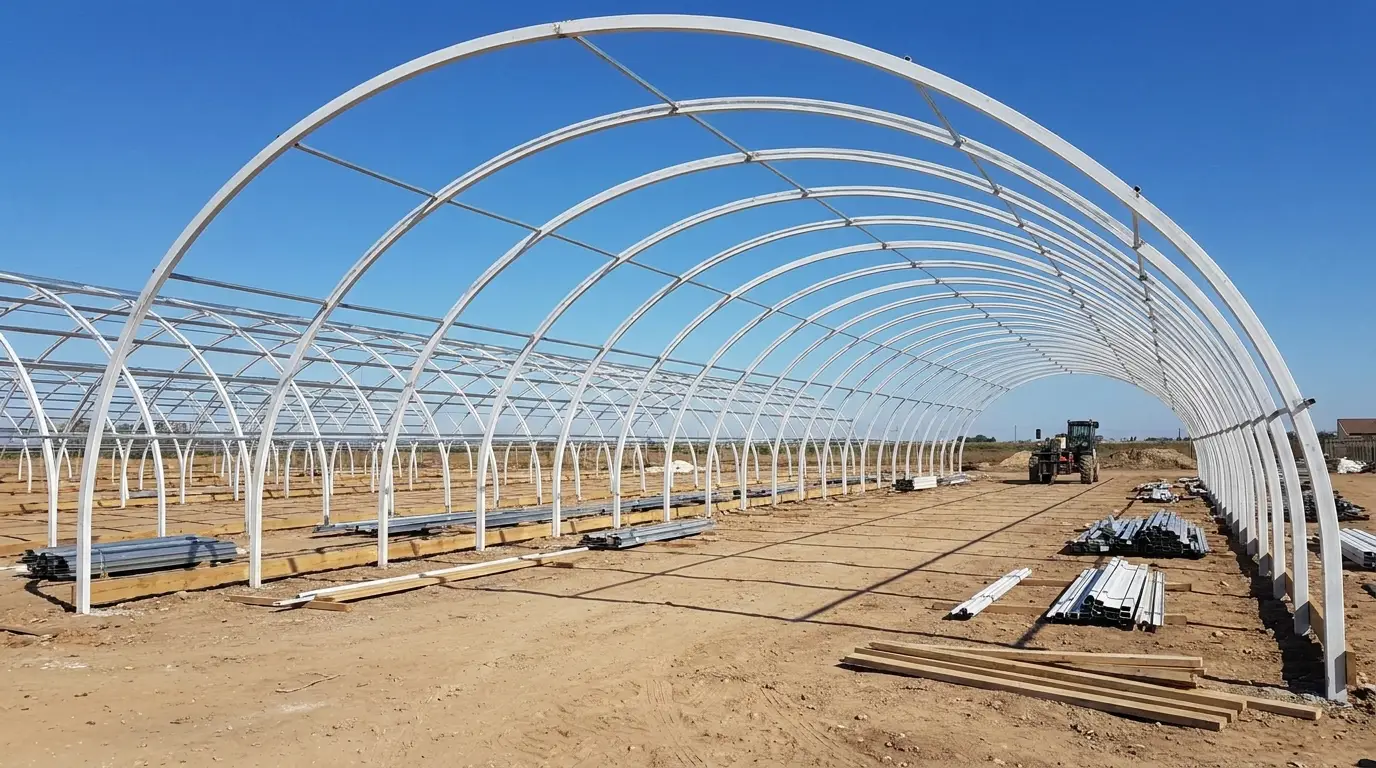
Which tube is used where in a greenhouse structure
Each element carries different forces — posts take vertical weight and sideways bending from wind, arches take the weight of snow, struts work in tension and compression. So each needs a different profile:
| Element | Profile and size | Why |
|---|---|---|
| Vertical posts (small greenhouse, width <5 m) | 40×40 or 50×50 mm square, 2.0 mm wall | A square section is equally strong in all directions — wind blows from any side |
| Vertical posts (farm-scale, 8–10 m) | 60×60 or 80×80 mm square, 2.0–3.0 mm wall | More width means more load per post |
| Arch rafters | 30×40×2 or 20×40×2 mm rectangular | Long side vertical — maximum resistance to bending under snow |
| Longitudinal struts (purlins) | 20×20 or 25×25 mm square, 2.0 mm wall | Work in tension-compression — a small section suffices and saves weight |
| Diagonals and internal bracing | 20×20 or 25×25 mm square, 2.0 mm wall | Axial forces — keep the arches from leaning sideways |
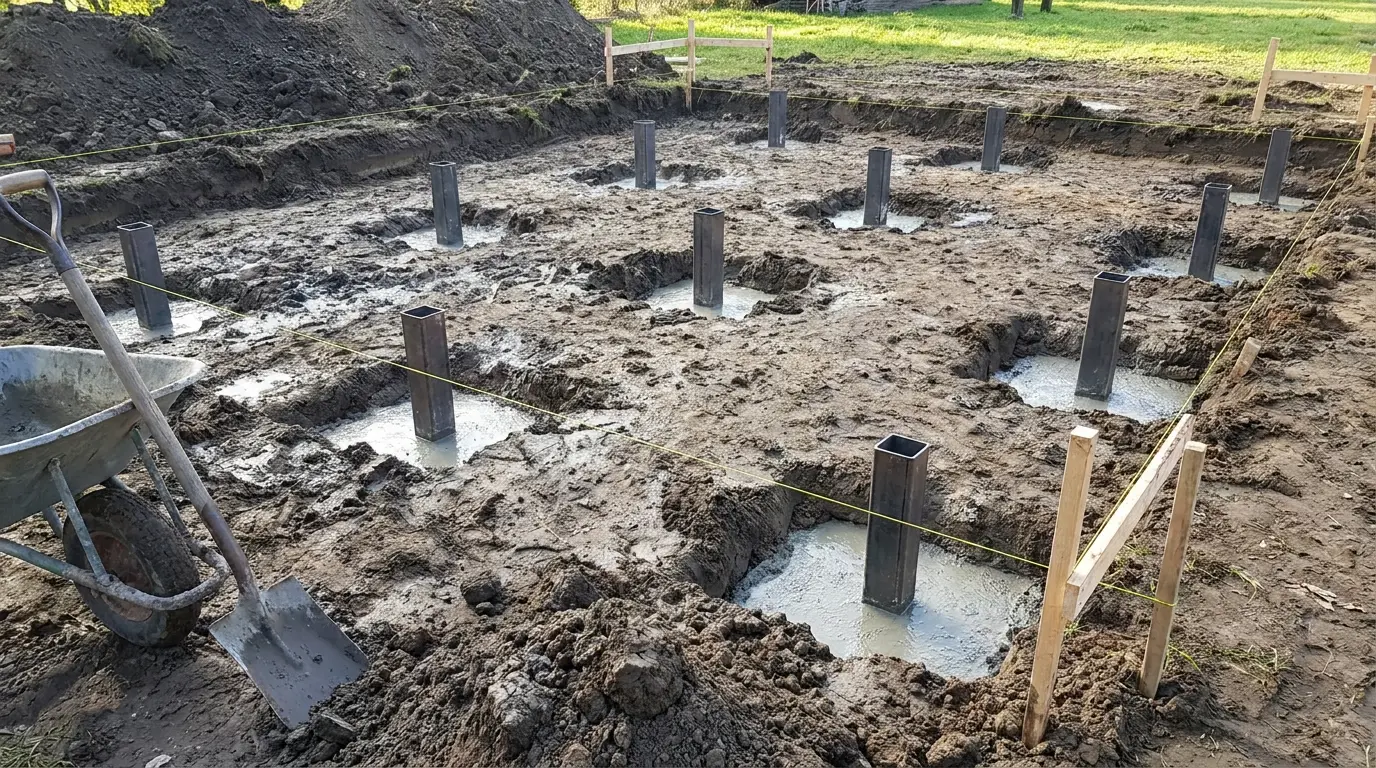
| Foundation sleeve | One size larger than the post (50×50 for a 40×40 post) | The post seats tightly and is locked with a bolt |
The strong-axis principle: when installing rectangular tube, the long side (40 mm) must stand vertical and the short side (30 or 20 mm) horizontal. This way the tube resists snow bending far better than a square tube of the same weight — you save steel without losing stiffness.
Snow load — the numbers that size the structure
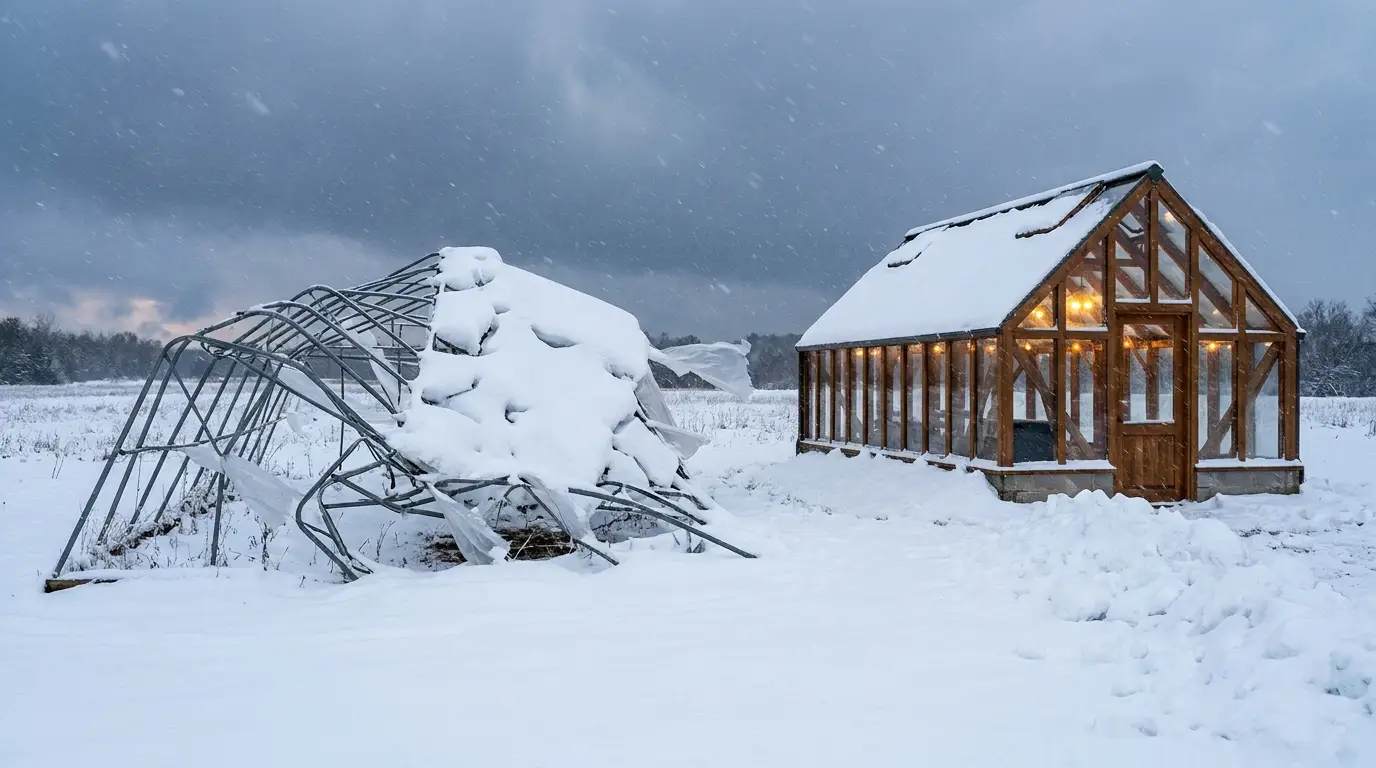
The classic mistake is looking only at snow depth — what matters is weight. In Batumi just 15 cm of wet snow puts 60–75 kg on each m² of roof, while in Akhaltsikhe 40 cm of dry powdery snow adds only ≈32 kg. On a 25° roof, 20 cm of wet snow is 90 kg/m² — a total of 9 tonnes on a 100 m² greenhouse! Below is what presses on each arch of a 400 m² (10×40 m) greenhouse with arches spaced 2.0 metres apart:
Snow load per arch — 400 m² greenhouse, 2.0 m spacing (kg)
The simplest lever for managing load is arch spacing: in a 6 m wide greenhouse, reducing the spacing from 1.5 to 1.0 m cuts the load per arch from 450 to 300 kg — a 33% reduction. And in greenhouses wider than 6 metres, trusses made of paired tubes are used instead of simple arches.
Snow load calls for engineering, not eyeballing: a structure built from wrongly sized tubes buckles under the first heavy snow and the whole investment is lost. In snowy regions choose a gothic (pointed) arch — snow piles up on the flat crown of a semicircular one. Our designs are always engineered for the snow and wind of your specific region.
The 9 stages of greenhouse structure assembly
This is how the handbook's 10×40 m black-steel greenhouse goes together — from marking out to operation:
Bracing the structure against wind and snow
- Diagonal wind bracing — in all four corners, run diagonal steel braces from the corner post towards the second and third arch to stop sideways sway
- Temporary winter props — before heavy snowfall, place temporary timber (10×10 cm) or steel props along the central path under the ridge of every second or third arch
- Painting is not optional — black steel with two-coat primer and white paint lasts 15–20 years; unpainted it rusts, and the white colour also keeps the film from overheating
- Heating in emergency mode — if the greenhouse is heated, during heavy snowfall raise the inside temperature to 15–18°C: the bottom snow layer melts and the mass slides off by itself
Frequently asked questions about structure assembly
What tube sizes does a 10-metre-wide farm greenhouse need?
In the handbook's 10×40 m project the vertical posts are 40×40×2 mm square tube, the arch rafters are 30×40×2 or 20×40×2 mm rectangular tube, and the struts and internal members are 20×20×2 mm. The general recommendation for posts of 8–10 m wide greenhouses is 60×60 or 80×80 mm — the final choice depends on your region's snow.
How far apart should the arches be?
The smaller the spacing, the less load each arch carries: in a 6 m wide greenhouse, reducing the spacing from 1.5 to 1.0 metres cuts the per-arch load by 33%. The 400 m² project uses 2.0 m spacing, but every arch is reinforced with internal support struts.
Why does a black-steel structure need painting?
Unprotected black steel rusts. Two coats of GF-021 anti-corrosion primer plus white paint give the structure a 15–20 year life, and the white colour reduces summer overheating of the metal, protecting the film from melting.
Can the structure be assembled without welding?
A black-steel structure requires on-site welding, while factory galvanized greenhouses bolt together and need no painting — but they cost more. See the comparison in greenhouse types and structures.
A structure that stands up to your region's snow
Send us your dimensions and location — in a [free consultation](/servisebi) you will get a design engineered for your region and an exact estimate. Under the [co-financing programme](/programa) the state can cover 50% of the cost.