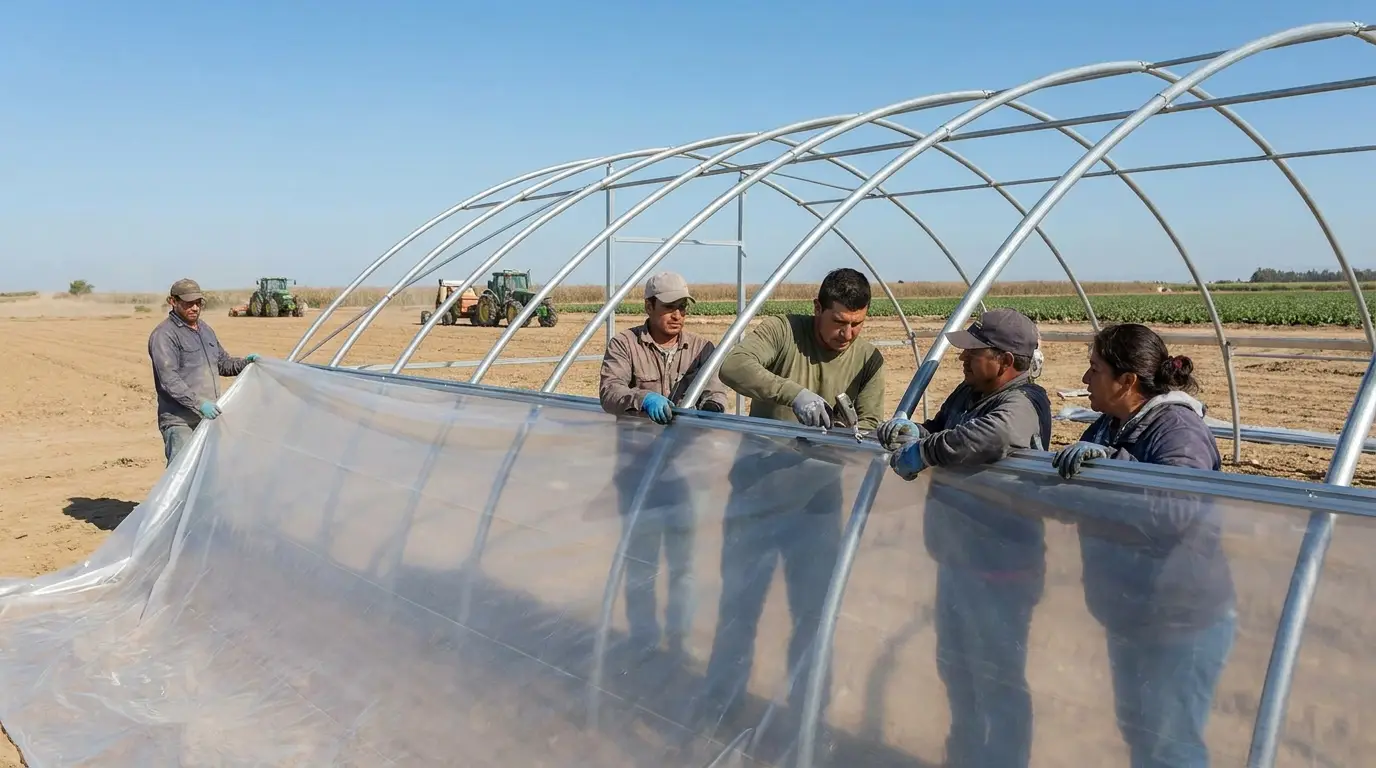
Greenhouse film must be installed on a completely windless day at 15–20°C: fix it on the central arch first, tension it evenly towards the ends, and lock the edges into an aluminium zigzag profile with spring wire (Wiggle Wire). Correctly chosen and well-tensioned film serves for years — neither strong wind nor precipitation will harm it. In this article, using a 400 m² (10×40 m) farm greenhouse as the example, we walk step by step through calculating the footage, tensioning and fastening, and the double inflated film system. If you are still choosing the material, start with the covering materials comparison.
How much greenhouse film you need and which materials
The footage logic is simple: the width adds up the arch length (10.7 m for a 10 m wide greenhouse), both side walls (1.8 m each) and a margin for burying the edges in the ground — at least 15.5 m in total, which is why a 16 m wide professional roll, available in Georgia, is used. Along the length, a 2 m reserve is added at each end of the 40 m greenhouse to cover the end walls — the film must be exactly 44 m. Here is the full list:
| Material | Purpose | Quantity (400 m²) |
|---|---|---|
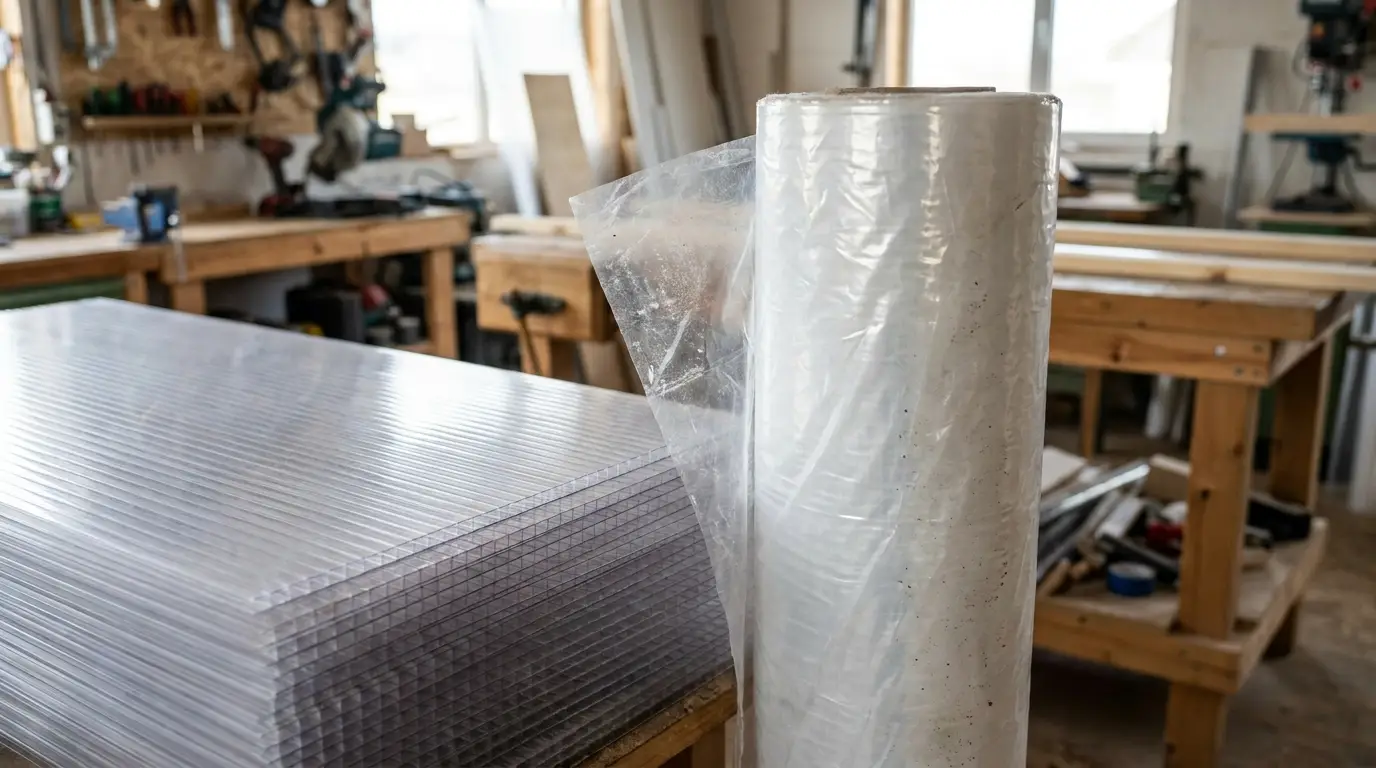
| Professional 180-micron, five-component film (UV + AC) | Main covering | 16×44 m (704 m²); confirm the price with the supplier |
| Aluminium zigzag profile | Channel for fastening the film on sides and end walls | 102 m (40+40 m sides, 11+11 m end walls) |
| Spring wire (Wiggle Wire) | Wavy wire — locks the film into the channel | 102 m |
| Thermal felt tape | Applied to the arches — protects the film from contact with hot metal | 250 m |
| Self-tapping screws | Fastening the profile to the tubes every 30 cm | set |
| Inflation blower | Double film only — blows air between the layers | 1 pc |
Installing the film step by step
Never install film in windy weather or at the wrong temperature. Installation requires a windless day and 15–20°C: in the cold the film is contracted — later, in the heat, it expands and sags; in strong heat it is over-expanded — when it cools it over-tightens. Sagging film flaps in the wind and wears out quickly.
The 2 m reserve left at each end covers the end walls. In the 400 m² project the front end wall gets a 1.0×2.0 m door in the centre, with a 1.0×0.8 m ventilation window above it; on the rear end wall, in the ridge zone, only a top window is made to expel hot air. On the end walls the film is fastened with the same zigzag profile — along the arch, 11 m on each side. Setting up the vents and roll-up sidewalls is a separate topic — see ventilation and airing.
Double inflated film — how it works
Double inflated film is the solution recommended by NYSERDA: the air cushion between the two layers cuts heat loss by 30–40% (light transmission drops by ≈10%). Use IRAC film as the inner layer — its anti-condensate coating stops droplets from hanging on the ceiling, while the infrared (IR) additive slows heat escape at night and saves an extra ≈20% of energy. The impact on heating bills in detail: heating and energy efficiency.
- One layer of professional film — 180 µm, five-component, with UV + AC protection
- Lasts 3–4 years thanks to the UV stabiliser
- No inflation blower needed
- The air cushion between the layers cuts heat loss by 30–40%
- Light transmission drops by ≈10%
- IRAC film as the inner layer — anti-condensate + IR additive, an extra ≈20% energy saving
- Needs an inflation blower — outdoor air, pressure kept at 50–100 Pa
The blower must take air from outside only: the air inside the greenhouse is very humid, and blowing it between the layers starts water condensation — condensate reduces light transmission, increases heat loss and spreads mould.
What damages greenhouse film most often
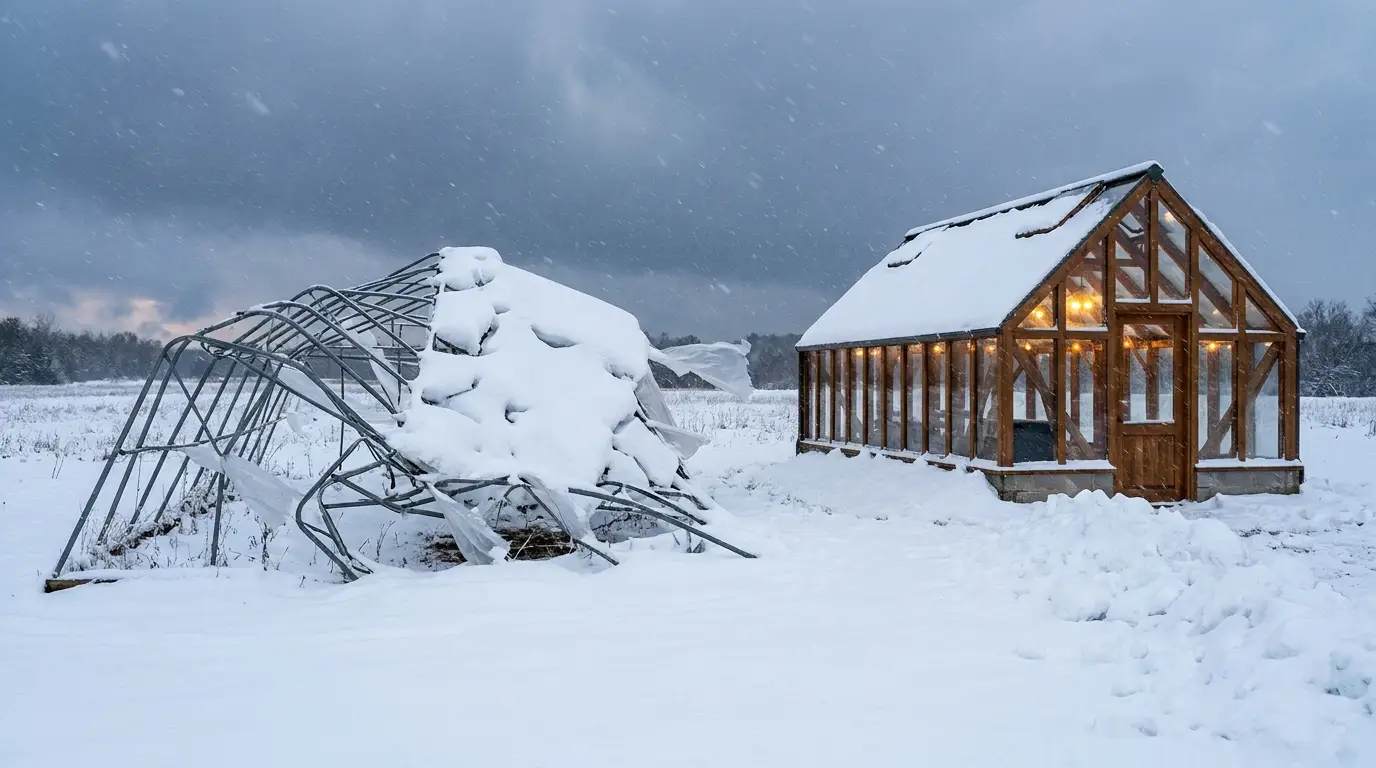
- Hot metal — in summer an unpainted tube heats up to 70°C and burns and tears the film at contact points; against this the structure is painted white and felt protective tape is applied to the arches
- Weak tension — sagging or wrinkled film flaps in the wind and wears out quickly
- Film without UV protection — ordinary polyethylene tears apart in the sun within months; professional film with a UV stabiliser lasts 3–4 years
- Installing in the wrong weather — film installed on a windy day or outside the 15–20°C range soon loses its tension
- Inflating with indoor air — in a double system, humid indoor air creates condensate and mould between the layers
Film installation: do it yourself or trust the professionals?
Pulling 704 m² of film over a 400 m² greenhouse is coordinated work for several people, and one mistake (installing in bad weather, uneven tensioning) costs you damaged material. Agro-Ornamenti's turnkey service builds a film greenhouse for 75–85 GEL/m² — the covering material, installation and handover are included in the price, and 50% of the cost can be covered by state co-financing. For a consultation on a specific job, see the services page.
Frequently asked questions about film installation
In what weather can film be installed?
Only on a completely windless day at 15–20°C. In the cold the film contracts, in strong heat it over-expands — in both cases the tension fails later.
How do I calculate how much film I need?
Width = arch length + both side walls + a margin for burying in the ground; length = greenhouse length + 2 m at each end. For example, a 10×40 m greenhouse needs film 16 m wide and 44 m long (704 m²).
Are the zigzag profile and spring wire really necessary?
They are the professional standard: the aluminium channel and wavy wire press the film evenly along its whole length and hold it reliably in the wind, and when needed the film is easy to remove and re-tension. A 400 m² project needs 102 m of profile and the same amount of wire in total.
Why can't double film be inflated with indoor air?
The air inside a greenhouse is very humid — once between the layers, the water condenses, which reduces light, increases heat loss and spreads mould. That is why the blower takes air from outside, and the pressure is kept at 50–100 pascals.
Want the film installed by professionals?
Send us your greenhouse dimensions — we will calculate the exact footage, select the film and hand over the installation on schedule. The consultation is free.